Billede

Date: October 14, 2026
Event: Supported Webinar
Time: 10:00–11:30 CEST
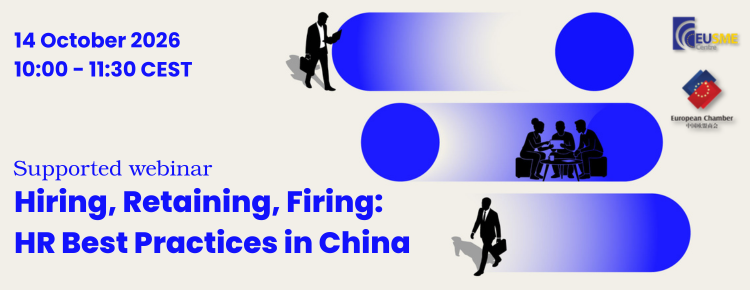
Understanding how to recruit the right people, manage a team and terminate contracts is as crucial in China as it is anywhere else. This knowledge is key not only because of the peculiarities of China’s human resources and labour regulations, but also, in the case of European SMEs with operations in China, because of the distance between headquarters and the local team.
On 14 October, the EU SME Centre and European Union Chamber of Commerce in China are organising a workshop in Beijing and online to share information on HR best practices with experts.
Date: 14 October, 2026
Time: 10:00–11:30 CEST
Location: Beijing & Online
This information session is open, free of charge, to all European SMEs and other stakeholders of the EU SME Centre, including business support organisations and trade promotion organisations, as well as public institutions from EU Member States and countries participating in the Single Market Programme
Date: October 30, 2026
Event: Supported Webinar
Time:
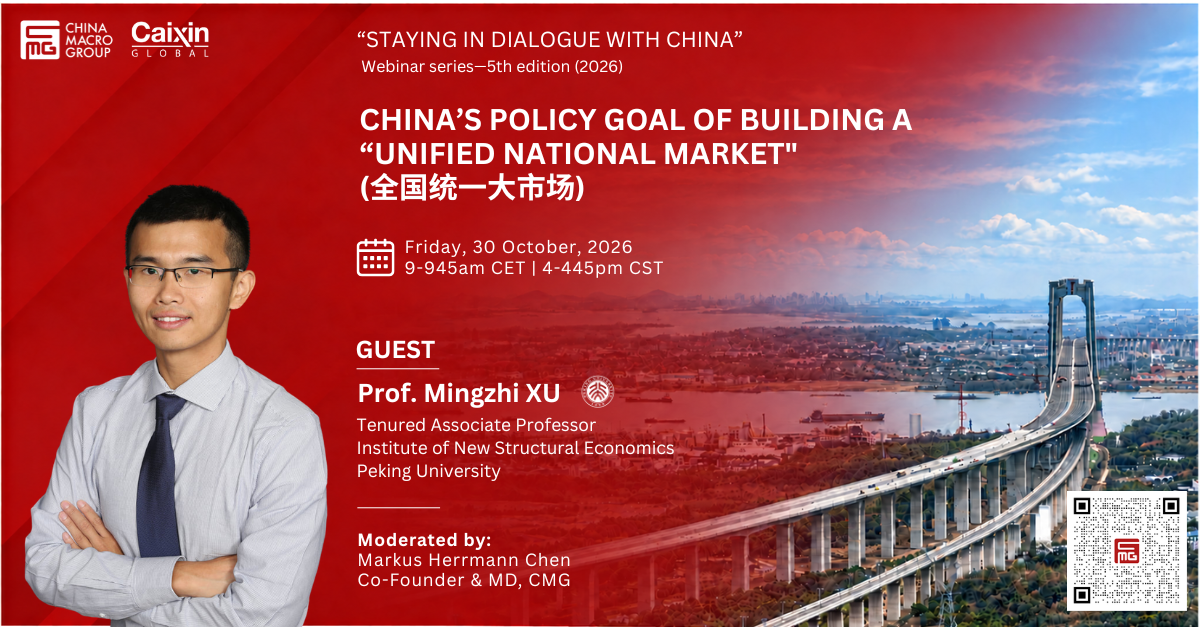
Join the upcoming “Staying in Dialogue with China” webinar on 30 October with Prof. Mingzhi Xu, Tenured Associate Professor at the Institute of New Structural Economics of Peking University (PKU) and a faculty member of the Yenching Academy.
For this session, China Macro Group focuses on China’s policy goal of building a “national unified market” (全国统一大市场), as a key issue shaping China’s political economy in 2026 based on priorities from the CCP Fourth Plenum (July 2024) and the Central Economic Work Conference in December 2025.
While the broad concept dates back several decades, it re-gained strategic importance across various iterations from 2018 (“strong domestic market” / 强大国内市场) to 2019 (“super-large scale market advantage” / 超大规模市场优势) to its eventual formalization as part of the 14th Five-Year-Plan (2021-2025) drafted in the first year of the Covid19 pandemic in 2020. After the pivotal “Third Plenum” in July 2024, we finally saw the NDRC publishing its key policy “Notice on Issuing the Guidelines for Building a Unified National Market (Trial), No. 1742” in December 2024.
More concretely, this webinar wants to discuss:
To discuss these questions, Markus Hermann Chen, Co-founder and Managing Director of China Macro Group will host Prof. Mingzhi Xu as guest speaker. Prof. Xu holds a Ph.D. in Economics from the University of California, Davis. During 2018 and 2019, he was a post-doctoral researcher at the National Bureau of Economic Research and a visiting researcher at Harvard Kennedy School (HKS), Harvard University. His research specialization includes international economics, industrial organization, economic development, consumer welfare, and infrastructure economics and financing. His research has examined topics including China’s trade liberalization, domestic sourcing, labour markets, and economic development.
Date: 30 October, 2026
Time: 09:00–09:45 CET / 16:00-16:45 CST
Location: Online
Date: November 18, 2026
Event: Supported Webinar
Time: 09:00-19:00 CEST
On 18 November 2026, the EU SME Centre will host the Understanding China Conference in Brussels and online. Bringing together policymakers from EU institutions, analysts, business leaders and industry experts, the conference will offer valuable insights into the latest developments shaping EU–China relations and the business environment for SMEs.
Through keynote speeches and expert panel discussions, participants will gain a better understanding of how evolving policies, market trends and wider developments may affect European SMEs operating in or engaging with China. The conference will also explore key areas relevant to companies looking to navigate the Chinese market, including changing consumer demographics and preferences, e-commerce, communication and marketing.
Date: 18 November, 2026
Time: 09:00–19:00 CEST
Location: Brussels & Online
Date: November 23, 2026
Event: Conference
Time: 10:00–16:00 (CST)
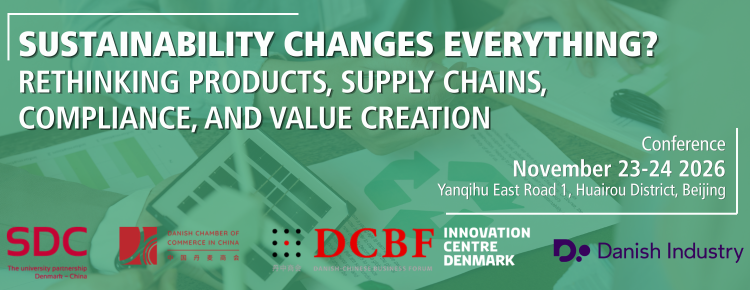
On 23–24 November 2026, Corporate Innovation Days 2026 will bring together companies, academics, researchers and students in Beijing for two days focused on sustainability and its impact on business.
The event will explore how sustainability is reshaping the way companies approach products, supply chains, compliance and value creation.
Across two days, participants can take part in keynotes, company pitches, panel discussions, workshops and networking, providing opportunities to exchange perspectives and connect across business and academia.
Speakers include representatives from:
Date: 23–24 November 2026
Venue: SDC Building, Yanqihu East Road 1, Huairou District, Beijing
Participation: Free of charge
Registration deadline: 10 November 2026
 Back
Back
Date: October 14, 2026
Event: Supported Webinar
Time: 10:00–11:30 CEST
Understanding how to recruit the right people, manage a team and terminate contracts is as crucial in China as it is anywhere else. This knowledge is key not only because of the peculiarities of China’s human resources and labour regulations, but also, in the case of European SMEs with operations in China, because of the distance between headquarters and the local team.
On 14 October, the EU SME Centre and European Union Chamber of Commerce in China are organising a workshop in Beijing and online to share information on HR best practices with experts.
Date: 14 October, 2026
Time: 10:00–11:30 CEST
Location: Beijing & Online
This information session is open, free of charge, to all European SMEs and other stakeholders of the EU SME Centre, including business support organisations and trade promotion organisations, as well as public institutions from EU Member States and countries participating in the Single Market Programme
Back
Date: October 30, 2026
Event: Supported Webinar
Time:
Join the upcoming “Staying in Dialogue with China” webinar on 30 October with Prof. Mingzhi Xu, Tenured Associate Professor at the Institute of New Structural Economics of Peking University (PKU) and a faculty member of the Yenching Academy.
For this session, China Macro Group focuses on China’s policy goal of building a “national unified market” (全国统一大市场), as a key issue shaping China’s political economy in 2026 based on priorities from the CCP Fourth Plenum (July 2024) and the Central Economic Work Conference in December 2025.
While the broad concept dates back several decades, it re-gained strategic importance across various iterations from 2018 (“strong domestic market” / 强大国内市场) to 2019 (“super-large scale market advantage” / 超大规模市场优势) to its eventual formalization as part of the 14th Five-Year-Plan (2021-2025) drafted in the first year of the Covid19 pandemic in 2020. After the pivotal “Third Plenum” in July 2024, we finally saw the NDRC publishing its key policy “Notice on Issuing the Guidelines for Building a Unified National Market (Trial), No. 1742” in December 2024.
More concretely, this webinar wants to discuss:
To discuss these questions, Markus Hermann Chen, Co-founder and Managing Director of China Macro Group will host Prof. Mingzhi Xu as guest speaker. Prof. Xu holds a Ph.D. in Economics from the University of California, Davis. During 2018 and 2019, he was a post-doctoral researcher at the National Bureau of Economic Research and a visiting researcher at Harvard Kennedy School (HKS), Harvard University. His research specialization includes international economics, industrial organization, economic development, consumer welfare, and infrastructure economics and financing. His research has examined topics including China’s trade liberalization, domestic sourcing, labour markets, and economic development.
Date: 30 October, 2026
Time: 09:00–09:45 CET / 16:00-16:45 CST
Location: Online
Back
Date: November 18, 2026
Event: Supported Webinar
Time: 09:00-19:00 CEST
On 18 November 2026, the EU SME Centre will host the Understanding China Conference in Brussels and online. Bringing together policymakers from EU institutions, analysts, business leaders and industry experts, the conference will offer valuable insights into the latest developments shaping EU–China relations and the business environment for SMEs.
Through keynote speeches and expert panel discussions, participants will gain a better understanding of how evolving policies, market trends and wider developments may affect European SMEs operating in or engaging with China. The conference will also explore key areas relevant to companies looking to navigate the Chinese market, including changing consumer demographics and preferences, e-commerce, communication and marketing.
Date: 18 November, 2026
Time: 09:00–19:00 CEST
Location: Brussels & Online
Back
Date: November 23, 2026
Event: Conference
Time: 10:00–16:00 (CST)
On 23–24 November 2026, Corporate Innovation Days 2026 will bring together companies, academics, researchers and students in Beijing for two days focused on sustainability and its impact on business.
The event will explore how sustainability is reshaping the way companies approach products, supply chains, compliance and value creation.
Across two days, participants can take part in keynotes, company pitches, panel discussions, workshops and networking, providing opportunities to exchange perspectives and connect across business and academia.
Speakers include representatives from:
Date: 23–24 November 2026
Venue: SDC Building, Yanqihu East Road 1, Huairou District, Beijing
Participation: Free of charge
Registration deadline: 10 November 2026
Date: juni 25, 2024
Time: 09:00-11:00
Event: Focus Group Meeting
Speaker: Michael Starbæk Christensen
Location: Danfoss new CPH HQ, Knud Højgaards Hus, Hauser Plads 1, 1127 København K
Unique opportunity to share knowledge such as challenges facing the Chinese market, as well as gaining insight into other members view of the current relationship between Denmark and China, together with the current ambassador to China
NB: This meeting will be conducted under the Chatham House Rule and is open by invitation only to DCBF members.
Date: juni 19, 2024
Time: 09:00-09:45 am (DK) / 03:00-03:45 pm (CN)
Event: Supported Webinar
This webinar is part of the webinar series 'Staying in Dialogue with China'. The series will bring you six webinars with distinguished China-based experts, concentrated between April and October 2024.
'Staying in Dialogue with China' is organized and hosted by China Macro Group (CMG), with Caixin Global as Anchor Partner, in cooperation with the China Europe International Business School (CEIBS), Chinaforum Bayern, Swissmem, the Swiss Chinese Chamber of Commerce (SCCC), the Danish-Chinese Business Forum (DCBF), SwissCham China, the Stein am Rhein Symposium (stars), and the Sweden-China Trade Council (SCTC).
In the third webinar of this year’s “Staying in Dialogue with China” webinar series, Co-founder and Managing Director of CMG, Markus Hermann, will talk to Prof. WANG Zhengxu, Professor at the Department of Political Science, School of Public Affairs at Zhejiang University about China’s “economic security” as a third structural transition as per CMG’s conceptual framework of China’s political economy.
From adopting the two policy concepts “holistic view of national security” (总体国家安全观) at the 19th Party Congress in 2017 and “coordinating development and security” (统筹发展和安全) with the 14th Five-Year-Plan in March 2021 respectively, Chinese policymakers have visibly made ‘risk management”, or in EU terms “de-risking”, a strategic priority in China’s policymaking in recent years. Even though economic security is only one of sixteen security concepts of China’s broad national security notion, we use it as the main term to discuss security interests of Chinese government with highest relevance for foreign business engaging in the Chinese market.
This development was driven by a confluence of factors at play in 2020, the main year of the drafting of the 14th FYP, including China’s hardened perception of the US’ intent to contain its further rise, persisting development challenges, previously introduced ideological reframing such as the “new era” and “high-quality development” and then, importantly, President Xi’s personal reflections in the form of a pivotal speech following the initial containment of the Covid pandemic in April 2020. Since the Central Economic Work Conference held at the end of 2023, however, a recalibration of security needs can be observed through policy articulations and new concepts such as the need for a “positive interaction” between “high-quality development” and “high-level security”.
Against this dynamic backdrop, this webinar discusses evolving security needs and risk perceptions of the Chinese government, the implementation of ‘economic security’ in China’s policymaking today – for instance through concepts and policies such as “self-reliance”, “bottleneck technologies”, “manufacturing champions”, “local supply chain ecosystems” or the “new system for mobilizing resources nationwide” – as well as what this means for foreign business.
Members of DCBF can register for free - Click here to read more and sign up!

Date: juni 18, 2024
Time: 9:00 am -10:00 am (DK) / 15:00 – 16:00 (CN)
Event: Webinar
Join us at this webinar to experience the fascinating story of how Hummel, one of the most iconic Danish fashion brands, managed to break through in the Chinese market and achieve strong growth while being true to its original brand DNA. Bjørn Karlsen, Brand Director at Leaf Digital and one of the main driving forces behind hummel’s success, will take you along on the journey from wrestling with distributor management, creating a relatable and authentic local brand image, running social and e-com channels to the all-important localized content production.
The webinar will also dig into the crucial question of how to create and support a long-lasting brand cycle in China, which is proving elusive for so many brands.
Click here to register (for DCBF, DCCC and DCCHK members only).
Speaker
Bjørn Ingwar Karlsen, Brand lead & partner at Leaf Digital

Bjørn Ingwar Karlsen has lived and worked in China for 15 years driving commercial success for Danish brands in the market. With a background that stretches across most aspects of working with branding in China, Bjørn has unique insights on how to run a foreign brand in China and avoid the many potential pitfalls. Currently, Bjørn is a partner at the Shanghai-Aarhus based digital agency Leaf Digital, where he is making sure clients are always on top of the developments in China’s fast-changing SoMe and e-commerce landscapes.
Date: juni 12, 2024
Time: 10:00 AM – 12:00 NOON (DK) / 04:00 PM – 06:00 PM (CN)
Event: Webinar
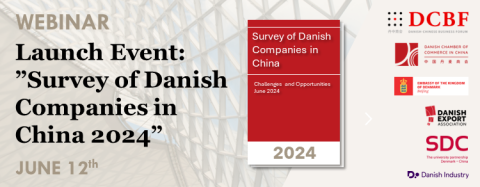
DCBF hereby invites our members to the launch event of the ‘Survey of Danish Companies in China 2024’, where the main findings of the survey will be presented, followed by a presentation of the current environment for Danish companies in China. The event takes place in Beijing, but members based in Denmark have the option to participate online.
Join us online for this hybrid event to keep yourself informed about the latest developments in China and to gain a deeper understanding of the business landscape for Danish companies in China.
Members of DCBF can register for free - Click here to read more and sign up!
About the survey
The Embassy of the Kingdom of Denmark in China, Beijing, Danish-Chinese Business Forum (DCBF), Sino-Danish Center for Education and Research (SDC), Danich Chamber of Commerce in China (DCCC) and Danish Export Association in China (DEA) have jointly produced the third edition of the Survey of Danish Companies in China. The first report was published in 2020 and the second in 2022. Based on comprehensive data from 91 companies, the survey provides an updated snapshot of Danish companies’ perceptions of their activities in China in 2024, in comparison to previous years.
The survey estimates the importance of China to the Danish business community, covering themes such as; their expectations on growth perspectives, challenges faced, local innovation and R&D levels, expectations concerning staffing and future investments, and the interesting question of the actual/planned level of decoupling, de-risking and China+1 issues.
Please contact info@dcbf.dk if you have any questions.

Date: maj 16, 2024
Time: 10:00-11:30 am (DK) / 04:00-05:30 pm (CN)
Event: Supported Webinar
How do the new regulations on cross-border data flows released by China change the compliance requirements for your business?
The implications of the Chinese restrictions on cross-border data transfers are a major cause for concern for foreign companies operating in China. DCBF recently conducted a webinar about the significant implications for businesses. However, given its current relevance and to ensure inclusivity for those who may have missed it, we cordially extend an invitation to you for this upcoming webinar hosted by the EU SME Centre and European Union Chamber of Commerce in China.
About the webinar:
The Cyberspace Administration of China (CAC) has recently introduced the “Regulations on Promoting and Regulating Cross-Border Data Flows”, which came into effect on 22 March 2024, replacing previous regulations from 2022. These new regulations bring about significant changes, such as relaxed timelines, reduced documentation requirements, and exemptions for data transfer, especially concerning employee data.
Despite the perceived relaxation and clarity brought by the new regulations, it is crucial to emphasize that stringent compliance requirements persist. Factors like cybersecurity, data security, and the Personal Information Protection Law (PIPL) are still strictly enforced, necessitating compliance efforts like data mapping, legal documentation, and privacy policies.
Join this workshop on May 16th, in Beijing and online, where industry experts will further explain the changes brought by the new regulations and offer practical guidance on the steps businesses should take to adhere to the new regulations.
Date: maj 15, 2024
Time: 09:00-09:45 am (DK) / 03:00-03:45 pm (CN)
Event: Supported Webinar
In the second webinar of the “Staying in Dialogue with China” webinar series, Co-founder and Managing Director of CMG, Markus Hermann, will talk to Prof. LU Feng, Emeritus Professor of Economics at the National School of Development (NSD) at Peking University, about China’s "Market-Oriented Reforms".
China kicked off its institutional reform from a centrally planned to a more market-oriented economy in the early 1980s under Deng Xiaoping, but – unlike the “shock therapy”-type liberalization of the Soviet Union – Chinese policymakers have been careful in introducing market forces in a gradual and dual-track fashion, essentially letting the market grow out of the plan. So, after 45 years, the state still plays a prominent role in China’s economy, even given the official policy goal that the market shall play a “decisive role” in allocating resources.
What are the roles of the “visible” and “invisible” hands in the market based on CCP ideology? How are factors of production (labor, capital, land, data) liberalized today? What are policy factors preventing more rapid liberalization in general? How to balance market forces and government interventions in view of China’s innovation and security needs? What is the link of ‘market-oriented reforms’ and ‘industrial upgrading’ as two structural transitions? What are policy trends regarding capital (state, private and foreign), e.g. the ‘mixed-ownership reform’? What is the reform logic for China’s financial system? How are anti-monopoly and IP protection evolving under the 14th Five-Year-Plan?
Members of DCBF can register for free - Click here to read more and sign up!
This webinar is part of the webinar series 'Staying in Dialogue with China'. The series will bring you six webinars with distinguished China-based experts, concentrated between April and October 2024.
'Staying in Dialogue with China' is organized and hosted by China Macro Group (CMG), with Caixin Global as Anchor Partner, in cooperation with the China Europe International Business School (CEIBS), Chinaforum Bayern, Swissmem, the Swiss Chinese Chamber of Commerce (SCCC), the Danish-Chinese Business Forum (DCBF), SwissCham China, the Stein am Rhein Symposium (stars), and the Sweden-China Trade Council (SCTC).
Date: maj 07, 2024
Time: (9:00-10:00 a.m. DK/3:00-4:00 p.m. CN)
Event: Webinar
Click here to register (for DCBF, DCCC and DCCHK members only).
Restrictions on cross-border data transfer have long been a cause for concern for foreign companies operating in China, and the Chinese regulators are seeking to address these concerns by lightening up the onerous requirements for cross-border data transfers.
On 28 September 2023, the Cyber Administration of China ("CAC") issued the Regulations for Standardizing and Promoting Cross-Border Data Flow ("Draft Regulations") to solicit public comments. The Draft Regulations appear to overturn some of their previous requirements in relation to cross-border data transfers. If adopted into law in its current form, the Draft Regulations would:
Create exemptions for many companies that export data or personal information from China in certain common business scenarios from otherwise mandatory data export approval procedures.
Raise the data transfer volume thresholds for the CAC's Security Assessment (a more onerous legal mechanism), and leave transfers of low-volume data to less onerous legal mechanisms.
Allow free trade zones to create "Negative Lists" for cross-border data transfers that are subject to mandatory data export procedures.
Almost half a year has lapsed from the day that the Draft Regulations were publicized, many foreign companies are still waiting for the Draft Regulations to be formally issued. In an official press conference on 5 February 2024, the director of the Department of Foregin Investment Management under the Ministry of Commerce said that the Cyberspace Administration of China is contemplating and improving the Draft Regulations and preparing for its promulgation.
In this webinar, Samuel Yang, Partner at Anjie Broad, will introduce all that you need to know about the Draft Regulations, their implications on your business, as well as observations of how multiple national companies are dealing with a time of uncertainty and their practical considerations.
Please contact info@dcbf.dk if you have any questions.
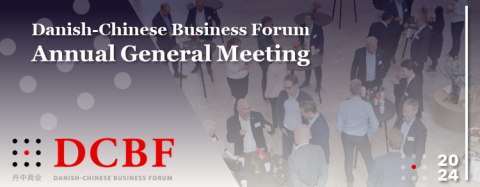
Date: april 19, 2024
Time: 9:00 - 13:00 CEST (Registration starts at 8:30)
Event: Annual General Meeting
Venue: LEGO Campus
About the Event
Danish-Chinese Business Forum is pleased to annouce this year's Annual General Meeting (AGM), which will take place 19th of April 2024. The AGM will be hosted by The LEGO Group at their LEGO Campus in Billund.
We are pleased to annouce our distinguished keynote speakers:
Edward Lewin, VP Government & Public Affairs at the LEGO Group, and Tom Behrens-Sørensen, Chairman of Danish-Chinese Business Forum will provide the welcome speech.
The focus of our AGM this year is the EU-China relationship and its implications for Danish companies working with and in China. We have invited several distinguished speakers to provide updates on these topics, which will be annouced in the weeks to come.
Click Here to Register (Only for Members of DCBF)
Date: april 05, 2024
Time: 9:00-9:45 CET 15:00-15:45 CST
Event: Supported Webinar
This webinar is part of the webinar series 'Staying in Dialogue with China'. The series will bring you six webinars with distinguished China-based experts, concentrated between April and October 2024.
'Staying in Dialogue with China' is organized and hosted by China Macro Group (CMG), with Caixin Global as Anchor Partner, in cooperation with the China Europe International Business School (CEIBS), Chinaforum Bayern, Swissmem, the Swiss Chinese Chamber of Commerce (SCCC), the Danish-Chinese Business Forum (DCBF), SwissCham China, the Stein am Rhein Symposium (stars), and the Sweden-China Trade Council (SCTC).
To kick this series off, Co-founder and Managing Director of CMG, Markus Hermann, will talk to Prof. Wang Yong, Academic Deputy Dean of the Institute of New Structural Economics at Peking Univarsity (PKU) about the first of the six transitions - economic transition and industrial upgrading, or the transition from a largely agrarian to an industrialized and then post-industrial society, increasingly driven by innovation.
What are the key success factors for China's transition to successfully overcome the so-called "middle-income trap"? Why is the focus for Chinese policymakers so much on manufacturing today? How to ensure industrial upgrading in times of geopolitics and geoeconomic factors? How does China's industrial policymaking differentiate by sectors, mature and emerging technologies and differing strategic goals? Is overcapacity unavoidable? And: what role does the new concept of "new-quality productive forces" (新质生产力) add to policymaking?
Members of DCBF can register for free - Click here to read more and sign up!
Back
Date: juni 25, 2024
Event: Focus Group Meeting
Speaker: Michael Starbæk Christensen
Location: Danfoss new CPH HQ, Knud Højgaards Hus, Hauser Plads 1, 1127 København K
Unique opportunity to share knowledge such as challenges facing the Chinese market, as well as gaining insight into other members view of the current relationship between Denmark and China, together with the current ambassador to China
NB: This meeting will be conducted under the Chatham House Rule and is open by invitation only to DCBF members.
Back
Date: juni 19, 2024
Event: Supported Webinar
This webinar is part of the webinar series 'Staying in Dialogue with China'. The series will bring you six webinars with distinguished China-based experts, concentrated between April and October 2024.
'Staying in Dialogue with China' is organized and hosted by China Macro Group (CMG), with Caixin Global as Anchor Partner, in cooperation with the China Europe International Business School (CEIBS), Chinaforum Bayern, Swissmem, the Swiss Chinese Chamber of Commerce (SCCC), the Danish-Chinese Business Forum (DCBF), SwissCham China, the Stein am Rhein Symposium (stars), and the Sweden-China Trade Council (SCTC).
In the third webinar of this year’s “Staying in Dialogue with China” webinar series, Co-founder and Managing Director of CMG, Markus Hermann, will talk to Prof. WANG Zhengxu, Professor at the Department of Political Science, School of Public Affairs at Zhejiang University about China’s “economic security” as a third structural transition as per CMG’s conceptual framework of China’s political economy.
From adopting the two policy concepts “holistic view of national security” (总体国家安全观) at the 19th Party Congress in 2017 and “coordinating development and security” (统筹发展和安全) with the 14th Five-Year-Plan in March 2021 respectively, Chinese policymakers have visibly made ‘risk management”, or in EU terms “de-risking”, a strategic priority in China’s policymaking in recent years. Even though economic security is only one of sixteen security concepts of China’s broad national security notion, we use it as the main term to discuss security interests of Chinese government with highest relevance for foreign business engaging in the Chinese market.
This development was driven by a confluence of factors at play in 2020, the main year of the drafting of the 14th FYP, including China’s hardened perception of the US’ intent to contain its further rise, persisting development challenges, previously introduced ideological reframing such as the “new era” and “high-quality development” and then, importantly, President Xi’s personal reflections in the form of a pivotal speech following the initial containment of the Covid pandemic in April 2020. Since the Central Economic Work Conference held at the end of 2023, however, a recalibration of security needs can be observed through policy articulations and new concepts such as the need for a “positive interaction” between “high-quality development” and “high-level security”.
Against this dynamic backdrop, this webinar discusses evolving security needs and risk perceptions of the Chinese government, the implementation of ‘economic security’ in China’s policymaking today – for instance through concepts and policies such as “self-reliance”, “bottleneck technologies”, “manufacturing champions”, “local supply chain ecosystems” or the “new system for mobilizing resources nationwide” – as well as what this means for foreign business.
Members of DCBF can register for free - Click here to read more and sign up!
Back
Date: juni 18, 2024
Event: Webinar
Join us at this webinar to experience the fascinating story of how Hummel, one of the most iconic Danish fashion brands, managed to break through in the Chinese market and achieve strong growth while being true to its original brand DNA. Bjørn Karlsen, Brand Director at Leaf Digital and one of the main driving forces behind hummel’s success, will take you along on the journey from wrestling with distributor management, creating a relatable and authentic local brand image, running social and e-com channels to the all-important localized content production.
The webinar will also dig into the crucial question of how to create and support a long-lasting brand cycle in China, which is proving elusive for so many brands.
Click here to register (for DCBF, DCCC and DCCHK members only).
Speaker
Bjørn Ingwar Karlsen, Brand lead & partner at Leaf Digital
Bjørn Ingwar Karlsen has lived and worked in China for 15 years driving commercial success for Danish brands in the market. With a background that stretches across most aspects of working with branding in China, Bjørn has unique insights on how to run a foreign brand in China and avoid the many potential pitfalls. Currently, Bjørn is a partner at the Shanghai-Aarhus based digital agency Leaf Digital, where he is making sure clients are always on top of the developments in China’s fast-changing SoMe and e-commerce landscapes.
Back
Date: juni 12, 2024
Event: Webinar
DCBF hereby invites our members to the launch event of the ‘Survey of Danish Companies in China 2024’, where the main findings of the survey will be presented, followed by a presentation of the current environment for Danish companies in China. The event takes place in Beijing, but members based in Denmark have the option to participate online.
Join us online for this hybrid event to keep yourself informed about the latest developments in China and to gain a deeper understanding of the business landscape for Danish companies in China.
Members of DCBF can register for free - Click here to read more and sign up!
About the survey
The Embassy of the Kingdom of Denmark in China, Beijing, Danish-Chinese Business Forum (DCBF), Sino-Danish Center for Education and Research (SDC), Danich Chamber of Commerce in China (DCCC) and Danish Export Association in China (DEA) have jointly produced the third edition of the Survey of Danish Companies in China. The first report was published in 2020 and the second in 2022. Based on comprehensive data from 91 companies, the survey provides an updated snapshot of Danish companies’ perceptions of their activities in China in 2024, in comparison to previous years.
The survey estimates the importance of China to the Danish business community, covering themes such as; their expectations on growth perspectives, challenges faced, local innovation and R&D levels, expectations concerning staffing and future investments, and the interesting question of the actual/planned level of decoupling, de-risking and China+1 issues.
Please contact info@dcbf.dk if you have any questions.
Back
Date: maj 16, 2024
Event: Supported Webinar
How do the new regulations on cross-border data flows released by China change the compliance requirements for your business?
The implications of the Chinese restrictions on cross-border data transfers are a major cause for concern for foreign companies operating in China. DCBF recently conducted a webinar about the significant implications for businesses. However, given its current relevance and to ensure inclusivity for those who may have missed it, we cordially extend an invitation to you for this upcoming webinar hosted by the EU SME Centre and European Union Chamber of Commerce in China.
About the webinar:
The Cyberspace Administration of China (CAC) has recently introduced the “Regulations on Promoting and Regulating Cross-Border Data Flows”, which came into effect on 22 March 2024, replacing previous regulations from 2022. These new regulations bring about significant changes, such as relaxed timelines, reduced documentation requirements, and exemptions for data transfer, especially concerning employee data.
Despite the perceived relaxation and clarity brought by the new regulations, it is crucial to emphasize that stringent compliance requirements persist. Factors like cybersecurity, data security, and the Personal Information Protection Law (PIPL) are still strictly enforced, necessitating compliance efforts like data mapping, legal documentation, and privacy policies.
Join this workshop on May 16th, in Beijing and online, where industry experts will further explain the changes brought by the new regulations and offer practical guidance on the steps businesses should take to adhere to the new regulations.
Back
Date: maj 15, 2024
Event: Supported Webinar
In the second webinar of the “Staying in Dialogue with China” webinar series, Co-founder and Managing Director of CMG, Markus Hermann, will talk to Prof. LU Feng, Emeritus Professor of Economics at the National School of Development (NSD) at Peking University, about China’s "Market-Oriented Reforms".
China kicked off its institutional reform from a centrally planned to a more market-oriented economy in the early 1980s under Deng Xiaoping, but – unlike the “shock therapy”-type liberalization of the Soviet Union – Chinese policymakers have been careful in introducing market forces in a gradual and dual-track fashion, essentially letting the market grow out of the plan. So, after 45 years, the state still plays a prominent role in China’s economy, even given the official policy goal that the market shall play a “decisive role” in allocating resources.
What are the roles of the “visible” and “invisible” hands in the market based on CCP ideology? How are factors of production (labor, capital, land, data) liberalized today? What are policy factors preventing more rapid liberalization in general? How to balance market forces and government interventions in view of China’s innovation and security needs? What is the link of ‘market-oriented reforms’ and ‘industrial upgrading’ as two structural transitions? What are policy trends regarding capital (state, private and foreign), e.g. the ‘mixed-ownership reform’? What is the reform logic for China’s financial system? How are anti-monopoly and IP protection evolving under the 14th Five-Year-Plan?
Members of DCBF can register for free - Click here to read more and sign up!
This webinar is part of the webinar series 'Staying in Dialogue with China'. The series will bring you six webinars with distinguished China-based experts, concentrated between April and October 2024.
'Staying in Dialogue with China' is organized and hosted by China Macro Group (CMG), with Caixin Global as Anchor Partner, in cooperation with the China Europe International Business School (CEIBS), Chinaforum Bayern, Swissmem, the Swiss Chinese Chamber of Commerce (SCCC), the Danish-Chinese Business Forum (DCBF), SwissCham China, the Stein am Rhein Symposium (stars), and the Sweden-China Trade Council (SCTC).
Back
Date: maj 07, 2024
Event: Webinar
Click here to register (for DCBF, DCCC and DCCHK members only).
Restrictions on cross-border data transfer have long been a cause for concern for foreign companies operating in China, and the Chinese regulators are seeking to address these concerns by lightening up the onerous requirements for cross-border data transfers.
On 28 September 2023, the Cyber Administration of China ("CAC") issued the Regulations for Standardizing and Promoting Cross-Border Data Flow ("Draft Regulations") to solicit public comments. The Draft Regulations appear to overturn some of their previous requirements in relation to cross-border data transfers. If adopted into law in its current form, the Draft Regulations would:
Create exemptions for many companies that export data or personal information from China in certain common business scenarios from otherwise mandatory data export approval procedures.
Raise the data transfer volume thresholds for the CAC's Security Assessment (a more onerous legal mechanism), and leave transfers of low-volume data to less onerous legal mechanisms.
Allow free trade zones to create "Negative Lists" for cross-border data transfers that are subject to mandatory data export procedures.
Almost half a year has lapsed from the day that the Draft Regulations were publicized, many foreign companies are still waiting for the Draft Regulations to be formally issued. In an official press conference on 5 February 2024, the director of the Department of Foregin Investment Management under the Ministry of Commerce said that the Cyberspace Administration of China is contemplating and improving the Draft Regulations and preparing for its promulgation.
In this webinar, Samuel Yang, Partner at Anjie Broad, will introduce all that you need to know about the Draft Regulations, their implications on your business, as well as observations of how multiple national companies are dealing with a time of uncertainty and their practical considerations.
Please contact info@dcbf.dk if you have any questions.
Back
Date: april 19, 2024
Event: Annual General Meeting
Venue: LEGO Campus
About the Event
Danish-Chinese Business Forum is pleased to annouce this year's Annual General Meeting (AGM), which will take place 19th of April 2024. The AGM will be hosted by The LEGO Group at their LEGO Campus in Billund.
We are pleased to annouce our distinguished keynote speakers:
Edward Lewin, VP Government & Public Affairs at the LEGO Group, and Tom Behrens-Sørensen, Chairman of Danish-Chinese Business Forum will provide the welcome speech.
The focus of our AGM this year is the EU-China relationship and its implications for Danish companies working with and in China. We have invited several distinguished speakers to provide updates on these topics, which will be annouced in the weeks to come.
Click Here to Register (Only for Members of DCBF)
Back
Date: april 05, 2024
Event: Supported Webinar
This webinar is part of the webinar series 'Staying in Dialogue with China'. The series will bring you six webinars with distinguished China-based experts, concentrated between April and October 2024.
'Staying in Dialogue with China' is organized and hosted by China Macro Group (CMG), with Caixin Global as Anchor Partner, in cooperation with the China Europe International Business School (CEIBS), Chinaforum Bayern, Swissmem, the Swiss Chinese Chamber of Commerce (SCCC), the Danish-Chinese Business Forum (DCBF), SwissCham China, the Stein am Rhein Symposium (stars), and the Sweden-China Trade Council (SCTC).
To kick this series off, Co-founder and Managing Director of CMG, Markus Hermann, will talk to Prof. Wang Yong, Academic Deputy Dean of the Institute of New Structural Economics at Peking Univarsity (PKU) about the first of the six transitions - economic transition and industrial upgrading, or the transition from a largely agrarian to an industrialized and then post-industrial society, increasingly driven by innovation.
What are the key success factors for China's transition to successfully overcome the so-called "middle-income trap"? Why is the focus for Chinese policymakers so much on manufacturing today? How to ensure industrial upgrading in times of geopolitics and geoeconomic factors? How does China's industrial policymaking differentiate by sectors, mature and emerging technologies and differing strategic goals? Is overcapacity unavoidable? And: what role does the new concept of "new-quality productive forces" (新质生产力) add to policymaking?
Members of DCBF can register for free - Click here to read more and sign up!